8 min read AI Development Product
Five Months Building OrdiClick with AI Agents
From vibecoding side projects to building a real product for restaurants with AI agents: a kitchen screen rebuilt five times, a simulated Saturday night and three price lists.
My first two experiments with AI were vibecoding: a small multiplayer 3D prototype, then SortDocs, a tool I actually use. Describe what you want, accept what comes back, fix it when it breaks.
Both had one thing in common: if they broke, nobody else noticed.
So the obvious next question was the uncomfortable one.
What happens when the thing you build with AI is meant for real customers, takes subscriptions and has to work in a kitchen on a Saturday night?
The answer, it turns out, is that it stops being vibecoding. It becomes what software development with AI agents looks like today: the agent writes most of the code, inside a process I own, made of plans, reviews, tests and simulations.
That’s OrdiClick: online ordering and management for restaurants, pizzerias, bars and shops.
It started with a very specific request. A pasta shop in Teramo was running its orders through WhatsApp and asked me to help them replace that with something more solid.
What started as a tool for one shop grew into a product for any place that takes orders the same way.
What OrdiClick Does
A venue gets its own address, like pizzeria.ordiclick.it, and a QR code.
From there:
- customers browse the menu, order at the table, for pickup or for delivery;
- the staff follow every order from a panel built for the middle of a service;
- the kitchen gets its own screen;
- reservations, loyalty cards, menus in English and simple analytics can be switched on when a venue needs them.
One decision shaped everything else: OrdiClick never touches the money. Customers still pay at the counter, in cash or by card, like they do today. No commissions on orders, no fiscal integration with the till, nothing to install. It runs in the browser.
Most of the five months went into details like this one, a single dish on the menu a customer sees after scanning the QR code:
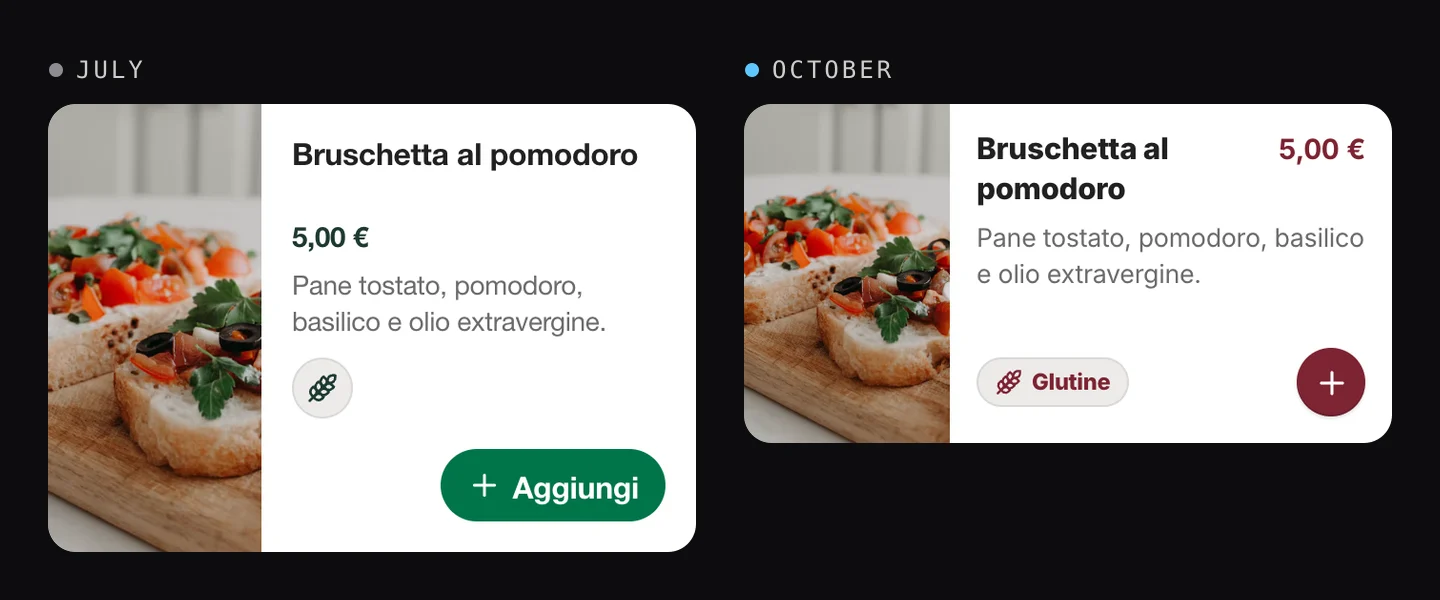 In July the allergen was an icon you had to guess. In October it says
“Glutine”, the price sits next to the name, and the venue’s own colour replaces
OrdiClick’s green.
The Numbers, First
The project started on May 22, 2026 under a different name, Easy Order. It became OrdiClick at the end of June.
Five months later:
- 1,260 commits;
- 315 database migrations;
- 236 test files on the frontend, plus SQL test suites for the database;
- about 740 commits co-authored by Claude, through Claude Code.
That last number is the honest summary of how it was built: more than half of the commits were written together with an AI agent. Almost none of them went in without me deciding what they should do, reading what came back and throwing a lot of it away.
Picking the model was the hardest call at the start. I tried GPT several times along the way and kept getting lower quality, so I stayed with Claude. That’s a snapshot of this moment, though: these models change every few months.
The stack is boring on purpose: Angular and TypeScript on the front end, Supabase (Postgres, row-level security, Realtime, Edge Functions) behind it, Stripe for subscriptions, Vercel for hosting.
Why This Was a Different Kind of Test
SortDocs could get away with being clever. OrdiClick can’t.
A restaurant panel is used by someone holding three plates, during the worst twenty minutes of their evening. Every extra tap costs something. Every wrong number on a ticket ends up as a wrong dish.
That changed how I worked with the AI more than any tool did.
With a side project, I could describe a feature and accept “it works”. Here, “it works” was the beginning of the conversation:
- does it work with fifteen venues at the same time?
- what happens after midnight, when “tonight” is technically tomorrow?
- what if two people book the last table in the same second?
- can one venue ever see another venue’s orders?
Those questions are where most of the 1,260 commits went.
The Kitchen Screen, Five Times
The best example of how the product actually got designed is the kitchen screen.
In August alone it went through five versions:
- lanes by menu category, all on one screen;
- one screen per station, with no sideways scrolling;
- a ticket-first rail, built around the orders instead of the dishes;
- “the queue”: one action at a time, nothing else on screen;
- a single expo screen, merging the previous ideas into one board.
Each version was quick to build. That’s the real superpower of working with an agent: trying an idea costs an afternoon, not a sprint.
But no version was chosen by the AI. Each one was replaced because it didn’t fit how a kitchen works in the middle of a service.
My favourite commit message from that month sums it up:
One kitchen notice instead of a stack, and only when it can stop a pan.
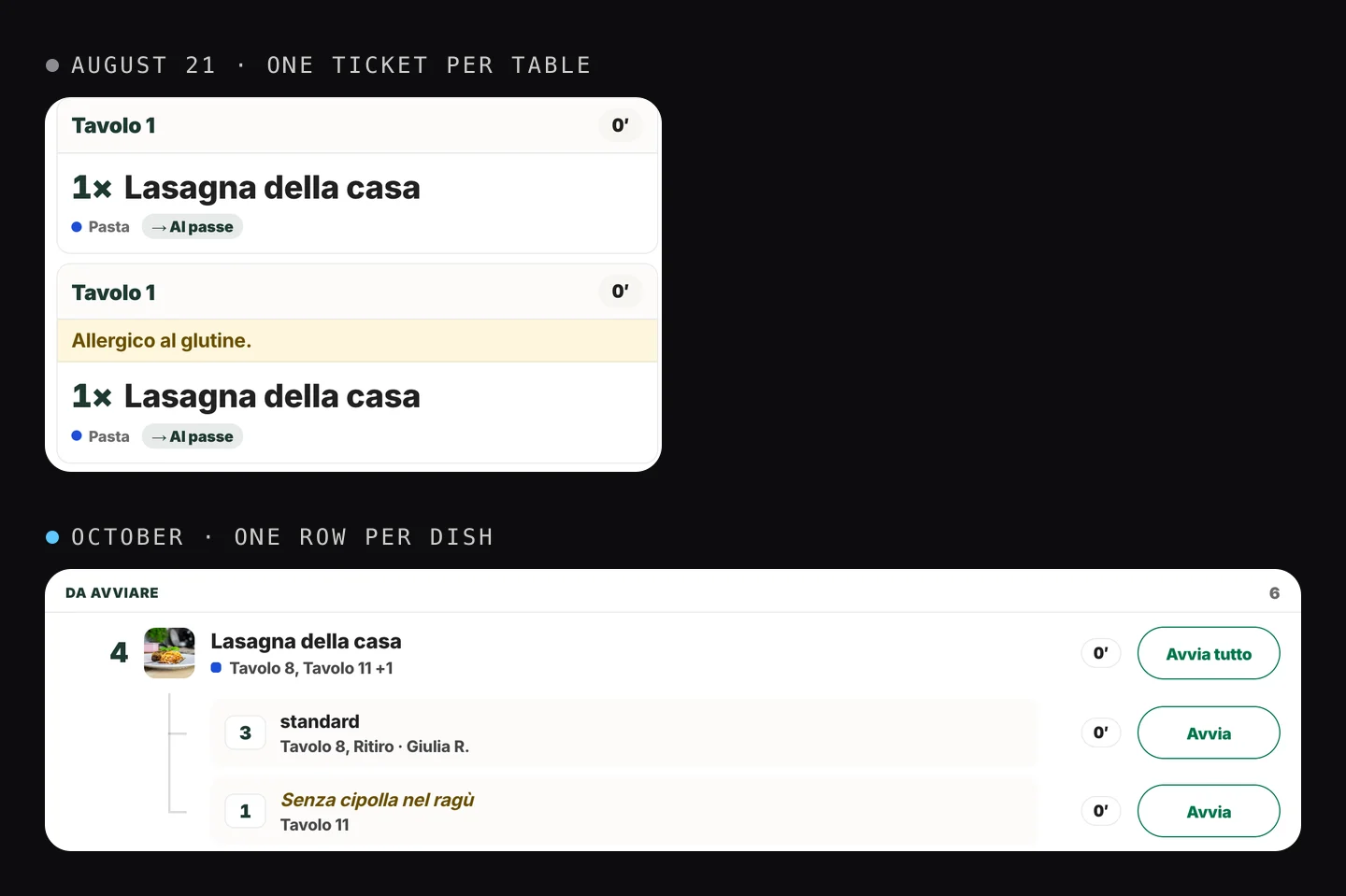 The biggest change wasn’t visual. The first version showed one ticket per
table. Today the kitchen sees one row per dish: four lasagne across three
orders, with the variant set apart, started with one tap.
A Saturday Night That Never Happened
In October I wanted to know if the whole thing would hold up, without waiting for a real Saturday to find out.
So I built one.
On a throwaway local copy of the backend, never production, I created 15 venues (pizzerias, osterie, bars, sushi places), a month of order history, delivery zones and riders. Then I ran all fifteen at the pace of a busy Saturday for ten minutes, while recording every request the real app made.
The results:
- zero technical errors across every run; the only rejected orders were business rules, like a minimum order or an address outside the delivery zone;
- no data crossing between venues, checked with dedicated tests on every Realtime channel;
- customer-facing calls stayed under 100 ms at the 95th percentile.
It also found real bugs, the kind no amount of clicking around would have shown me:
- two reservations for the last free table could both go through if they arrived together;
- after midnight, a delivery at 00:10 was assigned to the wrong rider, because “this evening” had silently become “tomorrow”;
- every new order pinged every rider: one checkout with five dishes and four riders sent 28 messages. After the fix, the whole evening went from 735 of those messages to 108;
- the rider page polled the server even when it was already receiving live updates. Fixing it cut those calls by 87%.
The most useful conclusion was a boring one: the limit was the hosting plan, not the code. At that pace, the free tier’s monthly quota of live messages would cover fewer than ten busy venues. The database itself barely noticed.
This is the part of the project I’d point to if someone asked whether building with AI agents scales. Not because the AI wrote correct code the first time, but because it made writing the simulation cheap enough that I actually did it.
Pricing, Three Times
Code wasn’t the only thing that took a few attempts.
The price list changed three times in three months:
- two plans in August;
- à la carte from September: a base menu plus ten features, each with its own monthly price;
- three plans since October 23: Menù at €9.90, Ordini at €24.90 and Completo at €34.90 a month.
À la carte looked fairer on paper. In practice, ten options with five dependencies between them asked a restaurant owner to make decisions in the dark, at the exact moment they were deciding whether to pay at all.
Three plans that match three kinds of venue (the trattoria with a QR menu, the place that takes orders, the one that delivers) turned out to be simpler for them and for me.
I don’t have reactions from real owners yet. My feeling is that these prices are on the low side: they’re set to keep the service running without losing money, not to make a profit. The first venues will tell me whether that’s right.
What the AI Did, and What It Didn’t
What it made possible:
- one person shipping a whole product: menus, orders, kitchen, reservations, loyalty, deliveries, subscriptions and a public demo;
- the work I would have skipped: load scripts, a fake month of orders, a simulated Saturday night;
- written reviews I could act on: critical passes on the backend and on every network call, kept in the repository next to the code they changed.
What stayed with me:
- what not to build: no native apps, no delivery aggregators, no integration with the till;
- the domain: the AI didn’t know that a restaurant’s evening doesn’t end at midnight, or that the kitchen and the dining room care about different things;
- saying no: five kitchen screens means four went in the bin, and the model is always happy to add one more button.
Where It Is Now
The pasta shop in Teramo that started all of this is starting to use OrdiClick right now, for its real orders. Until this week, everything in this post was tested against simulations and a demo, not real customers. Now it’s the WhatsApp chat against the panel, and I’ll find out which parts of the product actually hold up.
The next problem isn’t technical at all: it’s finding the venues after this one. That’s the part I know least about, and probably the subject of a future post.
If you run a restaurant, a pizzeria or a bar in Italy and want to try it, write to me.
Final Thoughts
With SortDocs, the question was whether vibecoding could produce a useful tool.
With OrdiClick, the question became whether building with AI agents could produce something other people can depend on.
My answer, after five months and with the first shop just starting to use it, is yes, with a condition: the AI made building cheap, so the work moved somewhere else. Into deciding what to build, into testing it as if a real Saturday night depended on it, and into throwing away the versions that weren’t good enough.
That part is still mine.